
(Image credit: The Straits Times)
What do Singaporeans really think about the Nominated Member of Parliament (NMP) scheme? After 35 years, nobody had actually asked them — until now.
In August 2025, OPPi conducted the first-ever community-led public consultation on the NMP scheme, surveying 500 nationally representative Singapore citizens. The findings were released on 18 September 2025 at a commemorative event co-organised by former NMP Anthea Ong and RICE Media, and the results sparked coverage across The Straits Times, RICE Media, Mothership, and The Online Citizen.
Here's what we found — and why it matters.
The NMP scheme was introduced in 1990 to give independent, non-partisan voices a seat in Parliament without having to contest elections. It became a permanent feature in 2010. But in early 2025, the scheme found itself in the spotlight for the wrong reasons.
Two sitting NMPs — psychiatrist Syed Harun Alhabsyi and lawyer Raj Joshua Thomas — resigned from their roles and joined the ruling People's Action Party ahead of the 2025 General Election. While constitutionally permissible, the swift transition from appointed non-partisan roles into party politics drew significant public criticism and raised questions about the scheme's integrity.
It was against this backdrop that OPPi partnered with former NMP Anthea Ong to run Singapore's first ground-up public consultation on the NMP scheme since its inception 35 years ago.
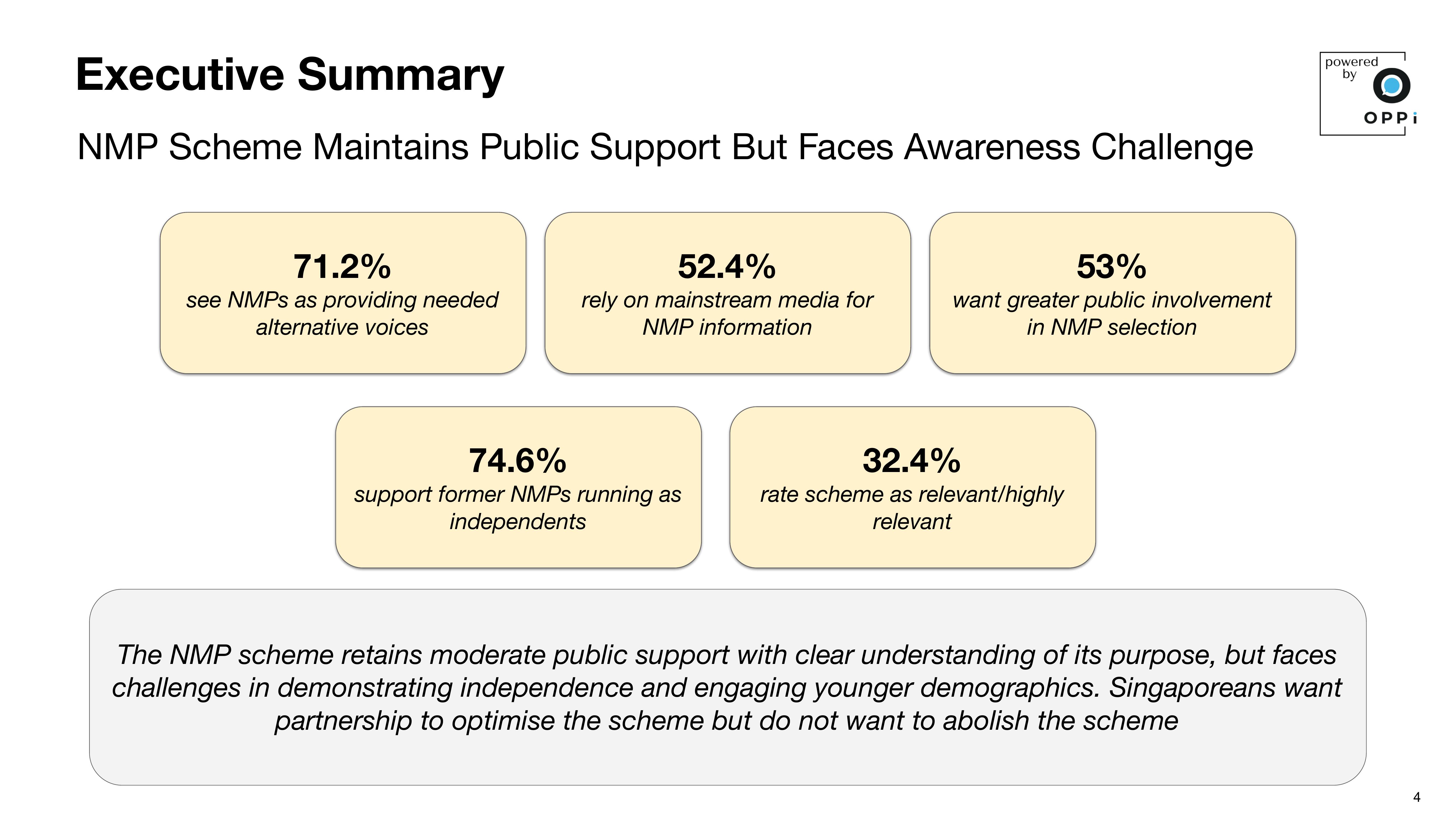
The headline finding was nuanced, and that's exactly the point. Singaporeans don't want the NMP scheme scrapped — but they do want it to evolve.
71.2% of respondents agreed that NMPs provide valuable alternative voices in Parliament.
That's a strong endorsement of the scheme's core purpose.
But when asked about relevance, only 32.4% said the scheme was "relevant" or "highly relevant" today, while 52.4% considered it only "somewhat relevant." The public supports the idea — but feels the execution needs updating.
74.6% supported former NMPs running as independent candidates over joining political parties.
On the question of NMPs joining political parties, the survey revealed that the public is far more supportive of former NMPs running as independent candidates than joining parties. Almost half of respondents also supported a cooling-off period before NMPs could stand for election.
Perhaps most significantly, 53% supported reforms to the selection process, with slightly over half wanting greater public involvement in choosing NMPs.
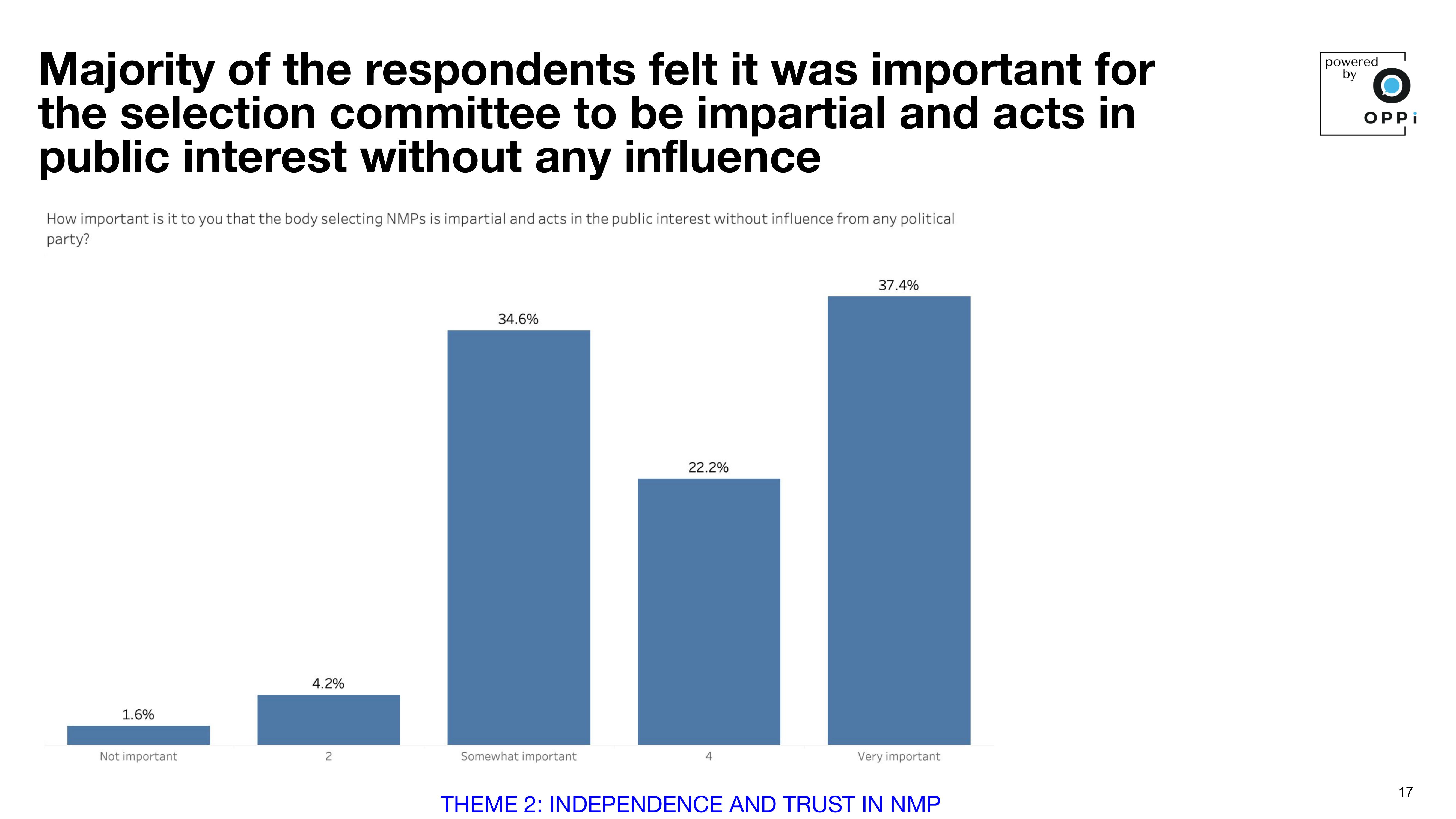
The data on independence was striking. A combined 59.6% of respondents rated it as important or very important that the body selecting NMPs is impartial and acts in the public interest without influence from any political party. Only 5.8% felt impartiality was unimportant.
53.6% expressed neutrality on trust in NMPs — reflecting a wait-and-see stance rather than outright distrust.
Higher familiarity with the NMP scheme correlated directly with higher trust: respondents with high familiarity showed 40.4% high trust versus just 22.2% for those with low familiarity. The average trust score rose from 2.95/5 for low-familiarity respondents to 3.27/5 for high-familiarity respondents — suggesting that awareness breeds confidence.
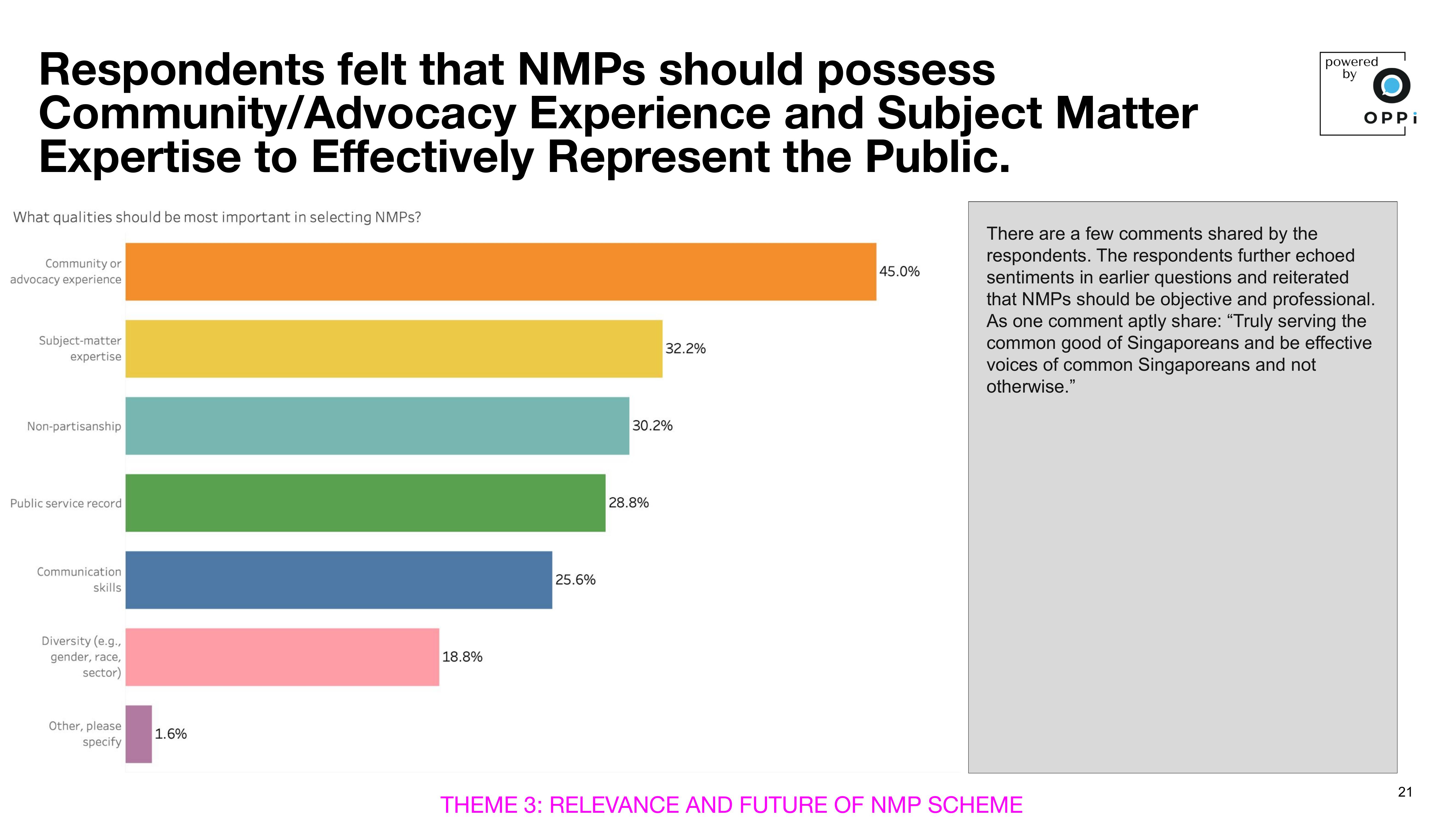
We asked respondents what qualities they valued most in NMP candidates. The results were clear: Singaporeans want NMPs who are rooted in community, not disconnected from everyday life.
Community or advocacy experience topped the list at 45.0%, followed by subject-matter expertise at 32.2%.
Non-partisanship came in at 30.2%, public service record at 28.8%, communication skills at 25.6%, and diversity considerations at 18.8%.
The message was reinforced in the open comments. As one respondent put it: NMPs should be focused on "truly serving the common good of Singaporeans."
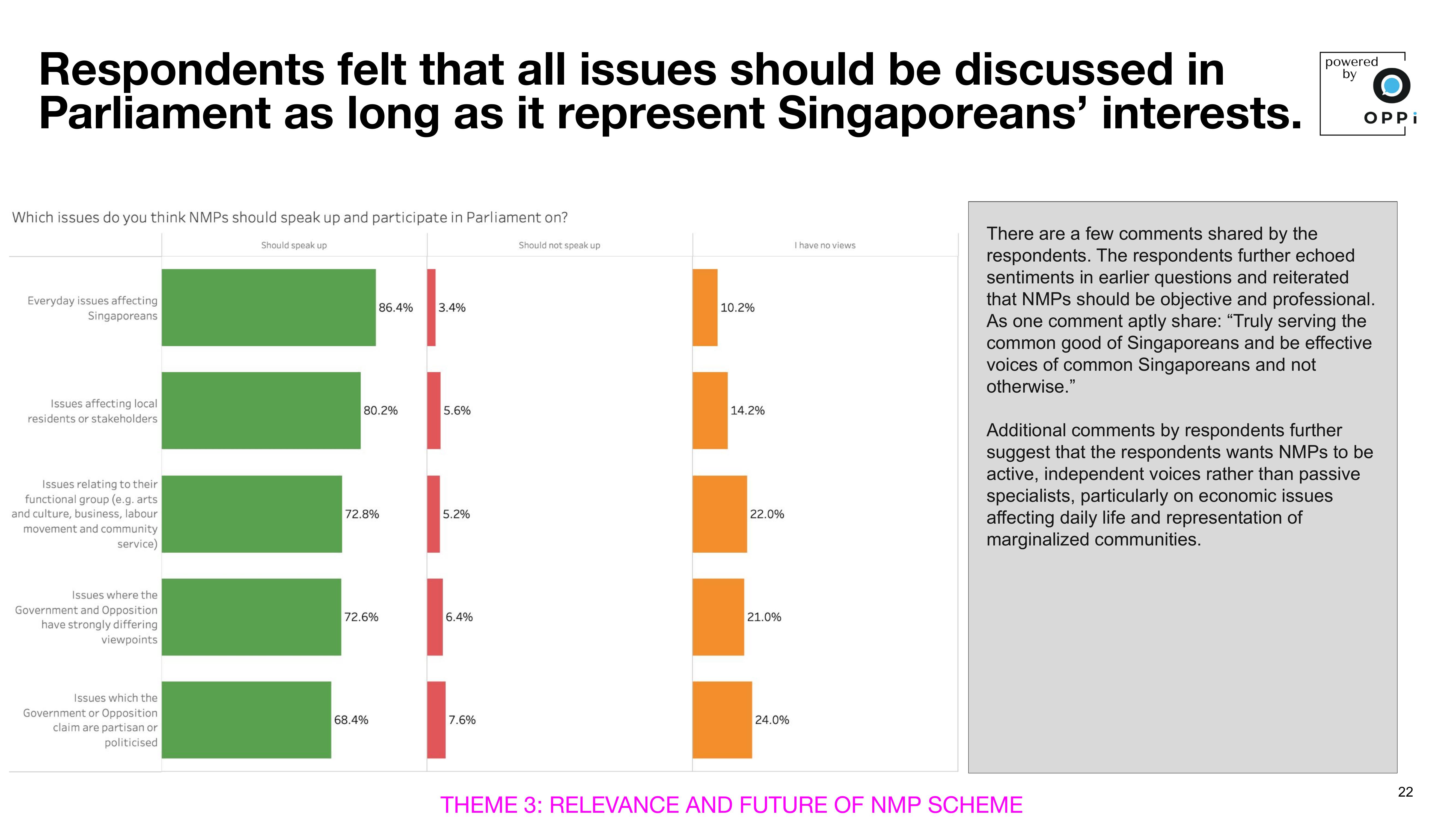
The public's expectations were equally clear on the issues NMPs should champion.
86.4% said NMPs should speak up on everyday issues affecting Singaporeans.
This was followed by issues affecting local residents and stakeholders (80.2%), issues relating to functional groups such as arts, business, and labour (72.8%), and even issues where the Government and Opposition have strongly differing viewpoints (72.6%).
In other words, respondents want NMPs to be active, independent voices — not passive specialists. They want representation that speaks to the lived reality of ordinary Singaporeans, not just sector-specific interests.
Beyond the quantitative findings, the open-ended responses revealed five distinct themes from 76 valid comments:
1. Democratic Legitimacy (23.7%) — Citizens want public participation in NMP selection. Comments like "Let people vote" and "Should open to public for voting" reflected a desire for more democratic processes.
2. Performance Legitimacy (13.2%) — Respondents questioned taxpayer value and demanded measurable impact and bolder advocacy from NMPs.
3. Representational Adequacy (11.8%) — There were calls for NMPs who understand ground realities and represent diverse communities, not just traditional elite sectors.
4. Independence Credibility (10.5%) — The recent NMP-to-party defections damaged trust. Respondents were clear: NMPs "should remain independent... not harbour agenda to join any party."
5. Institutional Transparency (10.5%) — The selection process was criticised as a "black box," with respondents calling for clearer procedures and greater openness.
A key statistical finding: respondents with higher NMP familiarity were significantly more likely to demand changes to the scheme (mean score 3.53 vs 3.11, p < 0.001). Interestingly, those who knew the scheme best also saw it as more relevant — suggesting that awareness breeds both trust and a desire for improvement.
The findings were presented on 18 September 2025 at a panel discussion held at RICE Media's office, moderated by Anthea Ong. The panel featured former NMPs Laurence Lien, Kuik Shiao-Yin, and Chandra Mohan Nair.
Former NMP Laurence Lien proposed a mandatory cooling-off period before NMPs could stand for election under any party. The event and survey findings were covered by The Straits Times, RICE Media, Mothership, and The Online Citizen — making it one of the most widely reported civic consultations in recent Singapore history.
A second round of the consultation — designed as an open, participatory survey — was subsequently launched to invite all Singaporeans to contribute their views, building on the initial nationally representative sample.
This consultation demonstrated exactly what OPPi was built for: giving people a voice on issues that matter, at scale, without the biases of traditional survey design.
The NMP consultation wasn't driven by a government agency or a political party. It was a ground-up initiative, powered by OPPi's AI-driven platform, that surfaced genuine public sentiment on a 35-year-old institution. The data told a story that social media alone could never capture — nuanced, representative, and actionable.
When we say "stop surveying, start hearing," this is what we mean.
Traditional surveys would have produced a simple approve/disapprove binary. OPPi uncovered the complexity beneath: a public that values the NMP concept but demands evolution, transparency, and accountability.
The survey of 500 Singaporeans reveals public support for the NMP scheme's core mission while identifying clear paths for strengthening democratic engagement and institutional effectiveness.
There's a direct correlation between awareness and trust. Singaporeans who understand the NMP role show significantly higher confidence in the institution. The path forward isn't about dismantling the scheme — it's about making it more transparent, more representative, and more connected to the citizens it was designed to serve.
If Parliament is truly to belong to the people, the conversation cannot end with just 500 respondents. It has to keep going.
View the full survey findings and methodology in our presentation slides. For more information about how OPPi can power your next public consultation or stakeholder engagement, get in touch.

How do we make the right decisions at the right time for the right issues and people?

In the time of home-based learning and online games, how can we protect our children from the dangers of the cyber world?

In the battle to eradicate gender inequality, where do we begin?
Find answers to common questions about OPPI.
With the free Pathfinder plan, you can ask a maximum of 20 questions per engagement session. There’s no limit with paid plans.
At OPPI, ensuring your safety is our utmost priority, reflecting our commitment to creating a secure and trustworthy environment. We are proud to hold the Cyber Essentials certification, issued by The IASME Consortium Ltd, which underlines our adherence to rigorous cybersecurity standards. This certification (ID: 8565506d-ded4-4983-9e1d-52d0c7b421b5) is a testament to our proactive stance on security, continuously updating our policies to safeguard your information and peace of mind.
OPPi starts analysing data immediately, but that information only becomes meaningful once you’ve heard from a few respondents. You’ll be able to view an analytics report on your session once you’ve had seven responses.
Yes. All data in your free account will be upgraded to the premium account.
Yes, if you have a Trailblazer or Explorer plan. If you have a Pathfinder plan, you’ll need to upgrade to view the raw data.
Yes, you can do that. We’ll need to customise your package and for that you’ll need our Explorer plan. Contact us so we can explore what you need and quote you.
Lots! Stay up to date by following us on Facebook, X, Instagram and LinkedIn, or send any suggestions or feedback to hello@oppi.live.

